Tuesday, January 22, 2013

Recent Cold Stun Arrivals Bring Patient Load to 25

With the eastern coast of the US experiencing one of the largest cold-stunning events in history, the South Carolina Aquarium's Sea Turtle Rescue Program has admitted 18 cold stunned sea turtles since December to help. In addition to the ten endangered sea turtles flown in by private pilot on December 5th from New England, 8 additional sea turtles that originally cold stunned North Carolina and New England were recently admitted.

North Carolina Cold Stun Admissions

On Thursday, January 10th, South Carolina Aquarium staff met Sarah Finn from the NC Wildlife Commission at the NC/SC border to transfer three juvenile loggerheads that had recently cold stunned in NC.

Sarah carries a bin with one of the loggerhead sea turtles to the Aquarium's husbandry van.
Each turtle was transferred to a new transport container.
The loggerheads travel in separate containers with padding. It is not necessary to transport them in water since they are air breathers. 

Manteo immediately crawled to the corner of the bin but then stayed quiet for the rest of the ride.
Kit stays calm during the medical evaluation.
The turtles receive full physical examinations.
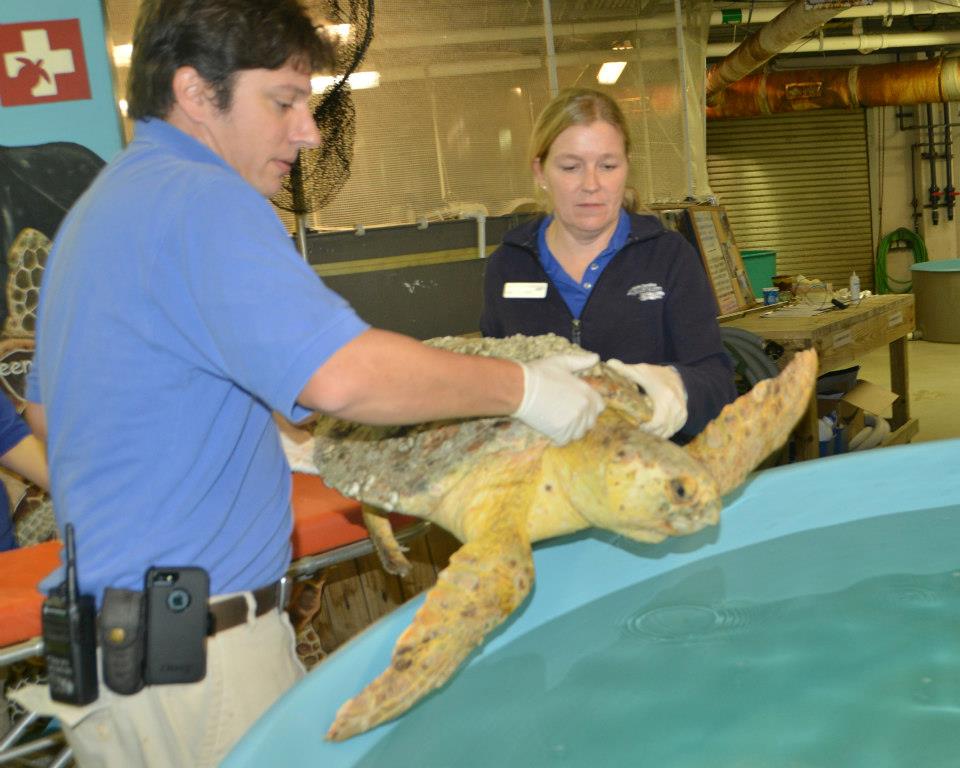
Buxton goes into the holding pool in the Aquarium's Sea Turtle Hospital.


New England Cold-Stun Admissions

On Monday, January 14th, five additional sea turtles were flown in by private pilot Michael Taylor from the Boston, MA area. The loggerhead and 4 Kemp's ridleys had been receiving treatment at the New England Aquarium's Animal Care Center.

The plane coming in for the landing at Atlantic Aviation in Charleston, SC.
The Piper Cheyenne 400 twin turboprop - a beautiful plane!
Owner and pilot, Michael Taylor lifts the juvenile loggerhead out of the cargo space...
...and hands it over to Kelly Thorvalson. What a gorgeous sea turtle!
Atlantic Aviation staff helps offload the boxes of Kemp's ridley sea turtles.
A close up photo of the loggerhead that has been named "Taylor" after the pilot. The purple band on the left flipper helped to identify the turtle during its stay at the New England Aquarium's Animal Care Center where many loggerheads are being treated.
The turtles get loaded into the Aquarium's husbandry van to be transported to the Sea Turtle Hospital.

Sea Turtle Biologist Christi Hughes and intern Joni Vaughn help to move the animals into the hospital.
The numbers on the sea turtles are for identification purposes at the New England Aquarium. With so many sea turtles in the tanks, these numbers kept staff organized with patient medications, medical procedures and feeding. 
Weights and measurements were taken and the turtles received full physical examinations.
They were then put into their respective holding tanks.
The Post and Courier and AP media were there to document the admission.
A Kemp's ridley with a healing neck lesion.
A Kemp's ridley with loss of keratin on the front of its face.
A huge THANK YOU to Michael Taylor for his generous donation of time and flight to get these animals safely to Charleston to finish treatment. Also to the hundreds of volunteers and donors that are instrumental in the rescue, transport, rehabilitation, and ultimate release of these sea turtles. 

With 25 sea turtles currently in treatment at the South Carolina Aquarium's Sea Turtle Hospital, it is a great time to visit! Learn more about the behind-the-scenes tours and visit them online by visiting the hospital webpage

Warmest wishes,
Kelly Thorvalson

Friday, January 4, 2013

Videos of Mini Ming and Ollie Enjoying a Healthy Snack!


The South Carolina Aquarium Sea Turtle Rescue Program wants to start your new year off with a smile! Enjoy the videos of Mini Ming and Ollie, two green sea turtles currently receiving treatment in the Aquarium's Sea Turtle Hospital, enjoying their favorite snack!
 
The Sea Turtle Hospital offers a variety of enrichment to all of its patients. One form of enrichment for green sea turtles is to offer vegetation. Hospital staff and interns have built feeders for the vegetables which allow the sea turtles to feed naturally from the bottom of the tank.
 
 
Mini Ming was found floating in Mingo Creek at Kiawah Island, SC. Notice the barnacles on the carapace (shell). A few larger barnacles on the carapace of sea turtles is normal and does not harm the animal. It is when a sea turtle becomes lethargic in the ocean for extended periods of time due to illness or injury that the barnacle load becomes so great, that secondary infection could result. 
 
 
Ollie was admitted to the Sea Turtle Hospital in October of 2012 with multiple boat strikes, the most severe to the upper jaw. We are thrilled to see how well Ollie is healing - the wound to his jaw has almost completely fused allowing him to eat with ease!
 
Come visit Mini Ming, Ollie, and the 15 other patients on a behind-the-scenes tour of our Sea Turtle Hospital!
 
Happy New Year!
Whitney Daniel

Tuesday, December 11, 2012

Hypothermic Sea Turtles Receive Private Flight to the South Carolina Aquarium


Private pilots in the Charleston area stepped up once again to help transfer endangered sea turtles in need of medical care. On December 5th, Gary Davis, pilot and owner of Davis Air, Inc. and pilot Neal McCann, transported 10 endangered sea turtles from Boston, MA to Charleston, SC to help lighten the load of the New England Aquarium's Marine Animal Rescue Program. The juvenile sea turtles, 8 Kemp's ridleys and 2 greens, were among over 150 that stranded along Cape Cod Bay in the largest cold stunning event in New England's history. This flight makes 3 times in the recent years that Charleston private pilots have helped transfer endangered sea turtles.

Gary Davis, Kelly Thorvalson, and Neal McCann in front of the Beechcraft King Air turboprop just before takeoff on Tuesday afternoon. 
At Norwood Airport just outside of Boston, MA, sea turtles were loaded onto the aircraft by New England Aquarium rescue staff Adam and Casey and South Carolina Aquarium staff Kelly Thorvalson. Pilots Gary and Neal packed the boxes safely into the plane.
In the air at approximately 21,000 feet, it was an extremely comfortable ride for the turtles. 

After the four hour flight from Boston to Charleston, the sea turtles were loaded into the Aquarium's husbandry van and transported to the Sea Turtle Hospital where they received physical examinations, blood work, radiographs, antibiotic injections, and fluid therapy to combat dehydration. Space is slim at the hospital and the turtles are small so they are sharing tanks. Dividers were installed to separate the solitary creatures so that when they start feeling feisty again, the biting that would normally occur is kept at bay.


Offloading the turtles for the transfer to the Aquarium.
Once at the Aquarium's Sea Turtle Hospital, turtles were sorted by number and needs.

Physical examinations on all patients: Although fluids were administered pre-flight, the turtles were mildy dehydrated. Many are thin and have lesions on their plastrons. 
Medical diagnostics and treatments included blood work, x-rays, fluids, and antibiotic injections.
Four of the ten juvenile sea turtles in their new home away from home.
Because cold-stunning of sea turtles rarely occurs off the SC coast, the South Carolina Aquarium Sea Turtle Rescue Program serves as a back-up facility for those areas that become inundated with the hypothermic reptiles. So far, 36 patients have been admitted to the Aquarium's hospital this year, a new record for the program. Currently, 18 sea turtles are receiving care.

Patient profiles and names are pictured here. The turtles will eventually be posted to the main hospital page so be sure to check back to learn about specific ailments and treatments.


A big thank you to pilots Gary Davis and Neal McCann of Davis Air, Inc. for donating the flight to help these animals! We are extremely grateful for their generous donation. Also thanks to Dr. Jose Biascoechea for his assistance with admission of these turtles. Anyone that is interested in visiting the Sea Turtle Hospital to see the patients can reserve a space on one of the regularly scheduled behind-the-scenes tours M, W, F, Sat and Sun at 11:30am and 1pm by calling the Aquarium's reservation desk at 843-720-1990.

All our best to the New England Aquarium team for their tireless efforts to help the sea turtles stranding on their shores. Visit their Marine Animal Rescue blog to learn more.

Follow these media links to see more on the turtle transfer:
Post and Courier 
News 2
Also, keep up with all the latest news from the South Carolina Aquarium on Facebook!

Happy Holidays!
Kelly Thorvalson
Sea Turtle Rescue Program Manager


Wednesday, November 21, 2012

A Third Annual Donation from the Sarkowski Triplets!

Three 9-year-old girls have become true benefactors of the sick and injured sea turtles recuperating in our Sea Turtle Hospital. For the third year in a row, McKae, Gracie, and Aubrey have encouraged their friends and family members to contribute to sea turtle conservation in South Carolina by donating funds to our non-profit Sea Turtle Hospital. 

2010 Donation


2011 Donation

This year, the triplets decided to reach out to their local community with phenomenal results. The girls discussed the plight of sick and injured sea turtles with local individuals and businesses, including Pitt Street Pharmacy, Royall Hardware, and the law firm J. Lynn McCants, LLC, and managed to raise an astounding $1,100!

2012 Donation
As Thanksgiving approaches and we begin to reflect on what we are thankful for in our daily lives, please let the children in your life know how much you appreciate them. It is truly astounding how much children can achieve when they have adults in their lives who believe in them. The staff, volunteers, and turtles in our Sea Turtle Hospital are very thankful for Aubrey, McKae, and Gracie!

Saturday, November 10, 2012

Three Sea Turtles of Three Species Released by Boat Bringing the South Carolina Aquarium to 99 Sea Turtle Releases!

On October 19, three sea turtles were released by boat just off SC's coast. Charlie and Merigo, a loggerhead and Kemp's ridley, were rehabilitated at the South Carolina Aquarium (SCA) and the third, a juvenile green sea turtle, was rehabilitated at the National Aquarium in Baltimore (NAIB). Releasing three species of sea turtles is very exciting and to make it even more exciting, the NAIB green was fitted with a satellite transmitter to track it's migration.


From Aquarium to Dock
The National Aquarium and South Carolina Aquarium staff met at 5:45am Friday morning to load the sea turtles for release. What an exhilarating way to start the day!

Olympian swims in his/her overnight home in the South Carolina Aquarium's Sea Turtle Hospital after being transported from the National Aquarium in Baltimore on Thursday.
Charlie makes a last big splash Friday morning before he gets loaded up to head home.
Gumby watches as wet Stephan and Chuck load Charlie into the transport container.

Merigo's transport container is much smaller than Charlie's. A little spray down and s/he was ready to go!


Olympian looks out from his/her transport container.
The turtles get pulled from the husbandry van and carried down the dock to the boat.
The small turtles are much easier to transport!
The Boat Ride
Special thanks to the boat owner John Hill and his crew, David and Charlie, for helping us release the turtles by boat. This was the fourth sea turtle release from the El Tejano in the last few years and we are grateful for the support! We also thank Joe and Jane Sylvan, Elena Terry, and the National Aquarium crew for being part of the release and making it that much more meaningful. Below are a few photos of the boat ride to release the turtles at 4KI, an artificial reef about 10 miles off the coast of Kiawah Island where water temperatures were 75 degrees F.

From left to right: first mate, Charlie Lewis; boat captain, David Redd; friends Elena Terry and Joe and Jane Sylvan; Chuck Erbe and Amber White from NAIB; Kelly Thorvalson from SCA; and owner of the El Tejano, John Hill.
Joe and John on the way out to the reef. Once there, these two helped release Charlie, the 150 pound loggerhead.
A beautiful morning!
John and Kelly chatting, most likely about sea turtles or fishing!
The Release
Merigo is a 9-pound juvenile Kemp’s ridley sea turtle, the most endangered of all of the sea turtle species. Merigo was brought to the South Carolina Aquarium with a group of sea turtles found cold stunned off the coast of Boston, Massachusetts and initially treated at the New England Aquarium. Because sea turtles are cold-blooded reptiles, they become hypothermic when exposed to extremely cold water temperatures. Merigo is the last of the MA group to be released.


Ready, set...
GO!
Swim, swim away! Good luck, Merigo!

Charlie is a 150-pound loggerhead sea turtle that was captured by the SCDNR In-Water Research Program in June. Charlie was injured by a stingray caught in the same net, the barb puncturing the front left flipper and neck. Because stingrays release venom from their barbs, medical treatment is necessary.

Charlie was anxious to go and was only on the side of the boat for about 5 seconds before being released!

Goodbye and good luck, Charlie!

Olympian is a 9-pound juvenile green sea turtle that was brought to the National Aquarium in Baltimore's Marine Animal Rescue Program (MARP) after being spotted floating off the New Jersey coast in August. Olympian was treated for over-inflated lungs and possible pneumonia. The National Aquarium team has attached a satellite tag to Olympian and hopes that the tag will lend insight as to where the turtle overwinters, and if/when it returns to the east coast next year. You can keep an eye on Olympian’s journey here.

Amber ready to release little Olympian!
SPLASH!
Good luck little Olympian! 
When you go to Olympian's tracking map, notice that within a day of the release 10 miles offshore, s/he had travelled right to the Charleston Harbor, not far from the South Carolina Aquarium! This is certainly not the best place for sea turtles because of the boat traffic but luckily, s/he made it out and is hugging the coast traveling north. Interesting that despite being released off the coast, his instincts brought him right back inshore!

Want More?
Check out the media articles about this release:

News 4 Charleston video and article
Post and Courier article
Post and Courier video and article

Thanks to all involved in the rescue, rehabilitation and release of these sea turtles. It takes an army to make it happen and each and every step along the way is so important!

Kelly Thorvalson and Whitney Daniel
Sea Turtle Rescue Program staff
South Carolina Aquarium