
.JPG) Once the turtle was admitted into the Aquarium's Sea Turtle Hospital, she was given supportive care to include fluid therapy, antibiotic and vitamin injections and diagnostics tests such as a blood analysis, ultrasound and radiographs (x-rays). Thousands of hatching marine leech eggs and some adult leeches were removed from the turtle's skin.
Once the turtle was admitted into the Aquarium's Sea Turtle Hospital, she was given supportive care to include fluid therapy, antibiotic and vitamin injections and diagnostics tests such as a blood analysis, ultrasound and radiographs (x-rays). Thousands of hatching marine leech eggs and some adult leeches were removed from the turtle's skin.

 Radiographs revealed an intestinal impaction (pictured below) and gas trapped on the right side of the intestinal tract, which is causing Santee to float at a severe angle. She is being held in very shallow water to keep her floating on a level plane and is receiving regular tubing of mineral oil and lactulose for aid in moving the impaction.
 Keep track of Santee's progress on the main hospital webpage and be sure to schedule a visit with her and all the other patients at the South Carolina Aquarium!
Huge thanks to Chad Ferris for recognizing this turtle needed help and responding. It is so important to recognize the part that our community plays in rescuing these threatened and endangered species. You are our eyes out there!
As always, we thank the SC Department of Natural Resources staff and volunteers for respondering to strandings and to the South Carolina Aquarium volunteers and that make this all possible.
Kelly


 Huge thanks goes out to Mark, Shannon, Audrey and Johnny Otis Smith for their willingness to stay with the injured sea turtle for 2 hours until its rescue. Also to Sarah Dawsey and Jerry Tupacz of USFWS for extending their work day (especially on Sarah’s birthday) and reacting so quickly to launch the boat. Lastly, huge thanks to Arturo Herrera from SCDNR for staying for 2 additional hours to help maneuver this huge animal around the Sea Turtle Hospital – I couldn’t have done it without him!
 With preliminary bloodwork completed, hospital staff were elated to get a PCV of 26, an indicator that the turtle had not lost a lot of blood. The wound was flushed with copious amounts of saline and with every syringe, the turtle flinched with pain. In addition to subcutaneous fluids and an antibiotic injection, Ripley received pain medications to make "him" more comfortable. Finally, the wound was packed with silver-sulfadiazine, an ointment with antibacterial and antifungal agents, and placed in a small tub with wet foam overnight.

.JPG) This wound is deep and it is difficult to see if lung tissue has been compromised. The prognosis is still guarded but we are hopeful for a full recovery.
This wound is deep and it is difficult to see if lung tissue has been compromised. The prognosis is still guarded but we are hopeful for a full recovery. 


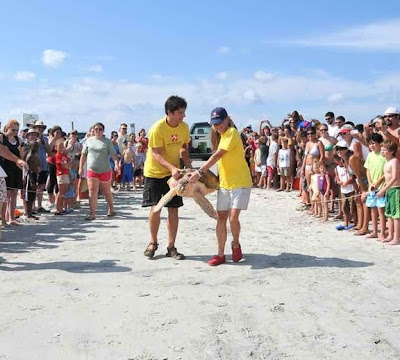

 Thanks to all that are involved in making this happen - there are too many to name but you know who you are!
 About four months after arriving at the Sea Turtle Hospital, the dead bone had finally all come out and healthy granulation tissue replaced open wounds. Keratin (the brown layer over the bone) also started its slow growth which would eventually provide stability and a protective barrier to the fractures.
 It took almost 2 years for the carapace to stabilize enough for the turtle to be released but that day finally arrived on August 24th. North Myrtle was released from the Aquarium's Scout boat a few miles off the coast of Folly Beach.
 .jpg)
.jpg)
.jpg)
.jpg) North Myrtle was not only a difficult medical case to treat but "she" was a difficult turtle to take care of - period. She was picky about the types of fish she ate, messy when she decided to eat, and consistently splashed her caregivers and anyone else that came close to her tank. Not only that, but staff and volunteers were ALWAYS having to squeegee water from around her tank to keep the area safe to walk. For all of these reasons and simply because she defied death, North Myrtle has left a lasting impression on any and all that met her. We wish her the best in that big (and dangerous) ocean out there.
North Myrtle was not only a difficult medical case to treat but "she" was a difficult turtle to take care of - period. She was picky about the types of fish she ate, messy when she decided to eat, and consistently splashed her caregivers and anyone else that came close to her tank. Not only that, but staff and volunteers were ALWAYS having to squeegee water from around her tank to keep the area safe to walk. For all of these reasons and simply because she defied death, North Myrtle has left a lasting impression on any and all that met her. We wish her the best in that big (and dangerous) ocean out there. 


.jpg)
 Sea turtle releases often draw large crowds so it is strongly advised that if you are attending, plan for heavy traffic onto Folly Beach and especially out to the County Park. Carpool if possible, as parking may be limited. We look forward to seeing you there!

