OLLIE
On Sunday, October 14th, a boater in the Folly River witnessed a small sea turtle being hit by the boat just ahead of him and was, fortunately, able to come to its rescue. Affectionately named Ollie from Folly, the 4.4 kg (~10 pound) endangered green sea turtle was transported by SC Department of Natural Resources Wildlife Biologist, Charlotte Hope, and was quite subdued during transport and admission.
Treatment included pain medication, antibiotic and vitamin injections, fluid therapy, and wound flushing. The turtle was intubated because it was not breathing on its own for several hours. Although the turtle was left in dry dock the first two nights, s/he is now residing in a filtered tank with a low water level.
 |
| The boat strike fractured the skull from the nares (nostrils) to the mandible (upper jaw). |
 |
| In addition to the fresh wounds on the anterior portion of the carapace, there are also several old wounds present on the posterior part of the shell and plastron. |
 |
| A combination of severe injuries and pain medication slowed Ollie's breathing considerably. The turtle was intubated so staff could breath for him during admission. |
 |
| Fluids were administered through a catheter in the axillary region of the body. |
.JPG) |
| Ollie was left on a ventilator overnight because he wasn't breathing on his own. |
NORTH ISLAND
On Friday, October 19th, a 44kg (~100 pound) loggerhead was captured in the net of a research vessel being operated by the SCDNR SEAMAP program just outside of North Island. The turtle sustained two puncture wounds from the barbs of stingrays that were caught in the same net and suffered severe blood loss as a result. Through the evening, the vessel made its way to Charleston, arriving at approximately 11pm. Needless to say, it was a late night for the rescue team!
Angry sea turtles don't like to stop moving, so it was a battle to get the bleeding stopped. Constant pressure was applied to the wounds (it was primarily the front flipper wound that kept bleeding). Because of blood loss, the turtle suffered from a very low PCV and blood protein; therefore, hetastarch fluids were administered IV. In addition, sodium chloride was administered subcutaneously and antibiotics and vitamins were given.
 |
| All attempts were made to keep the turtle quiet and to stop the bleeding from the wound on the ventral side of the front right flipper. |
 |
| The barb wound to the ventral side of the right front flipper is indicated in this photo. |
 |
| Wounds were examined and treated, blood taken, and supportive care given to the turtle. |
Both turtles are now residing in filtered tanks in the Aquarium's Sea Turtle Hospital. You can follow the progress of these patients and all the sea turtles being treated in our Sea Turtle Hospital
here. Huge thanks to all involved in the rescue of these injured sea turtles and to Barbara Bergwerf for her neverending photographic support.
Kelly Thorvalson
Sea Turtle Rescue Program Manager


.JPG)


 This new stranding brings the Aquarium's sea turtle patient load to 20, the most ever treated at once. But coastal waters are quickly warming and the Sea Turtle Rescue Team is looking forward to releasing many of the rehabilitated patients over the next month or so. Releases are temperature dependant so the dates are not determined yet. Keep checking back to the blog if you are interested in finding out more about these releases.


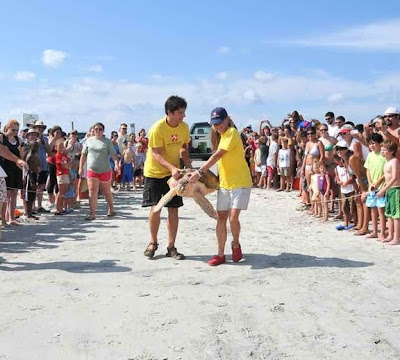

 Thanks to all that are involved in making this happen - there are too many to name but you know who you are!